Full-Stack Performance Tracking Portal with Next.js & Supabase
Full-stack goal-tracking portal with role-based access, quarterly check-ins, auto-scoring, audit logs & CSV export. Built with Next.js & Supabase.
Preview Gallery
6 media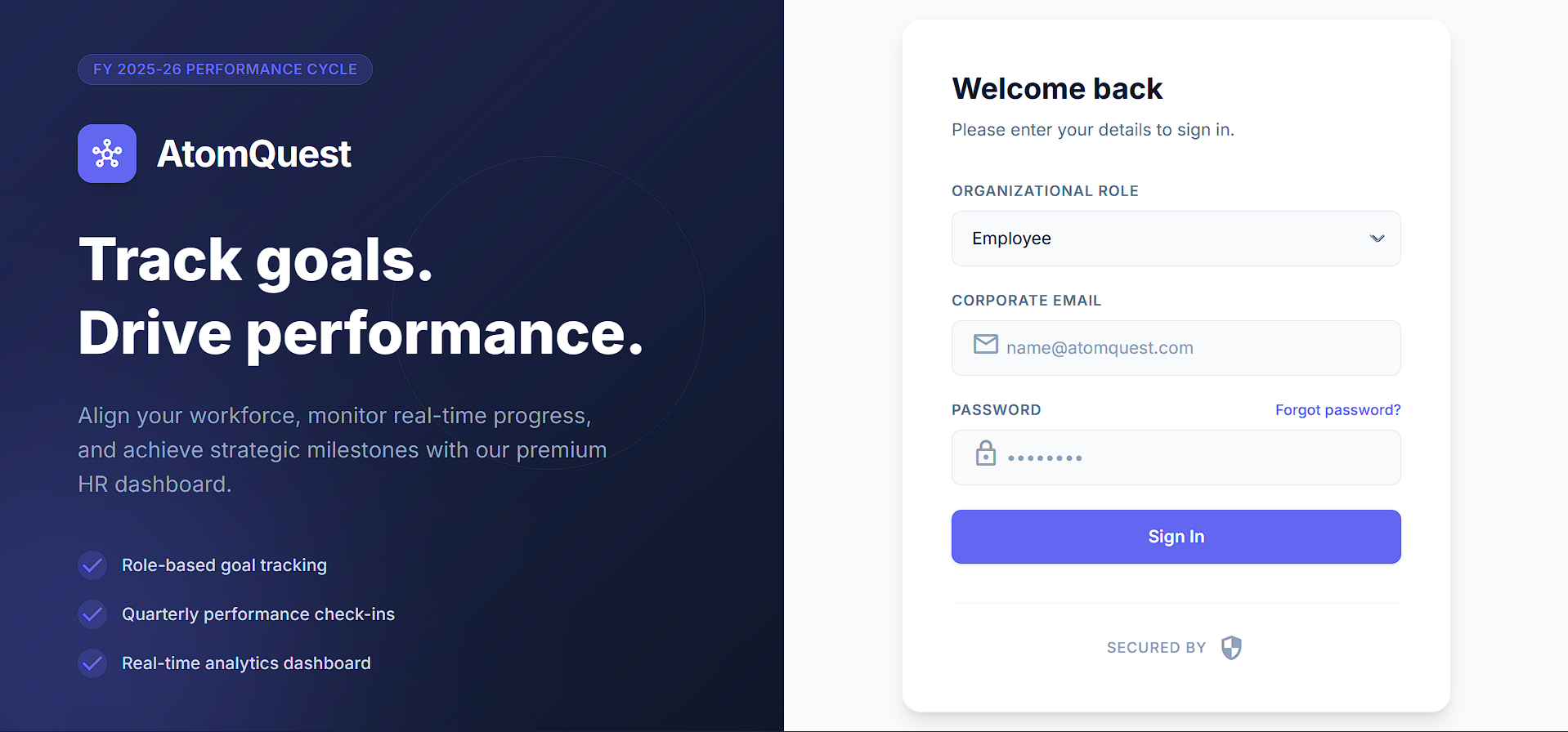
Technologies & Skills
Tags
Limited time offer
Full source code with role-based access control, Row Level Security, and a custom scoring engine — production-grade architecture, not a toy demo. Includes complete documentation, setup guide, and demo credentials for instant testing. Built with a modern, in-demand stack (Next.js 14, Supabase) and ready to deploy or extend.
What's Included
Support & Customization
Custom features, integrations, or UI changes available on request. Typical turnaround: 3–5 days depending on scope. Pricing discussed based on requirements — st...
Resource Links
Purchase this project to unlock source and premium resources. Document/report remain secure preview-based on this page.
What It Does
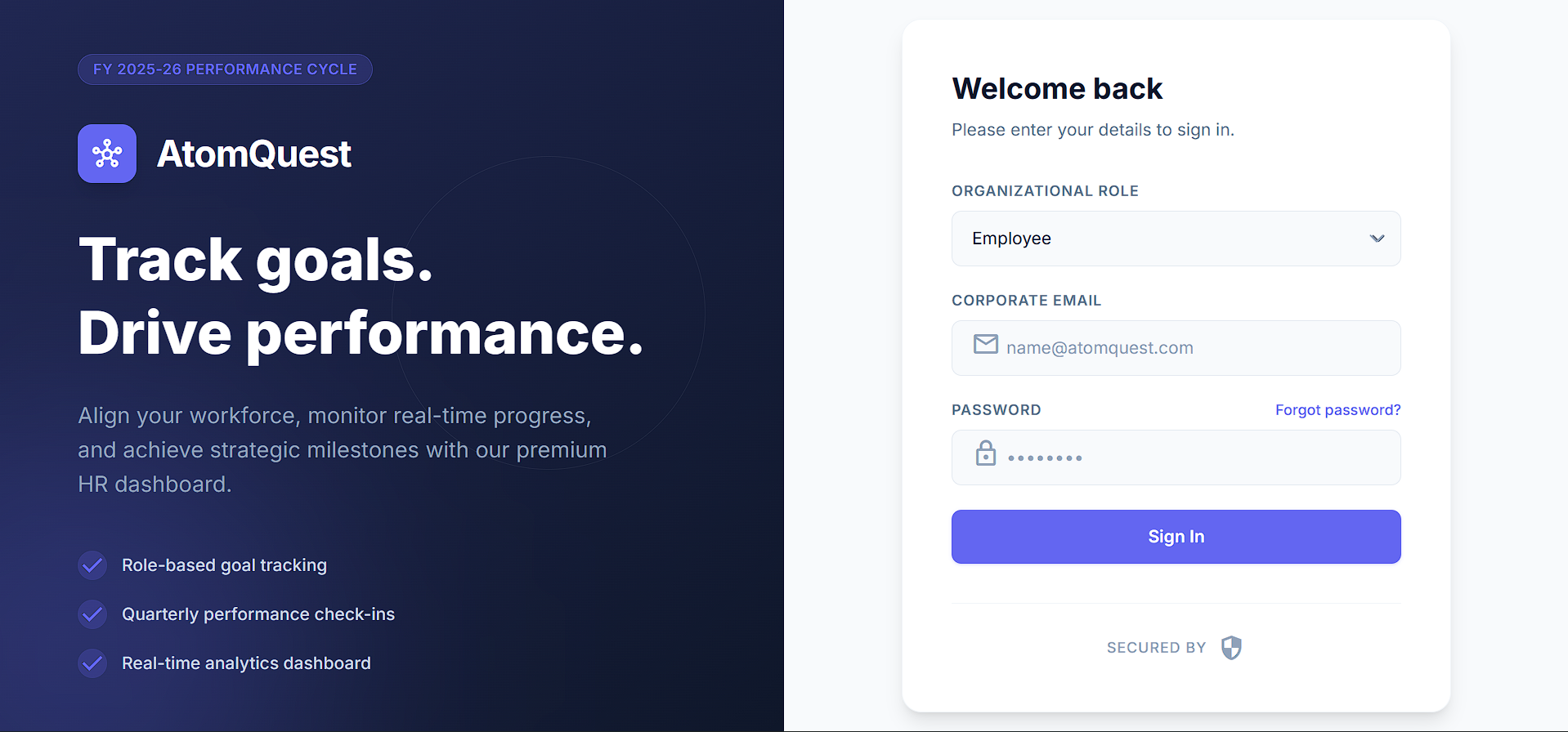
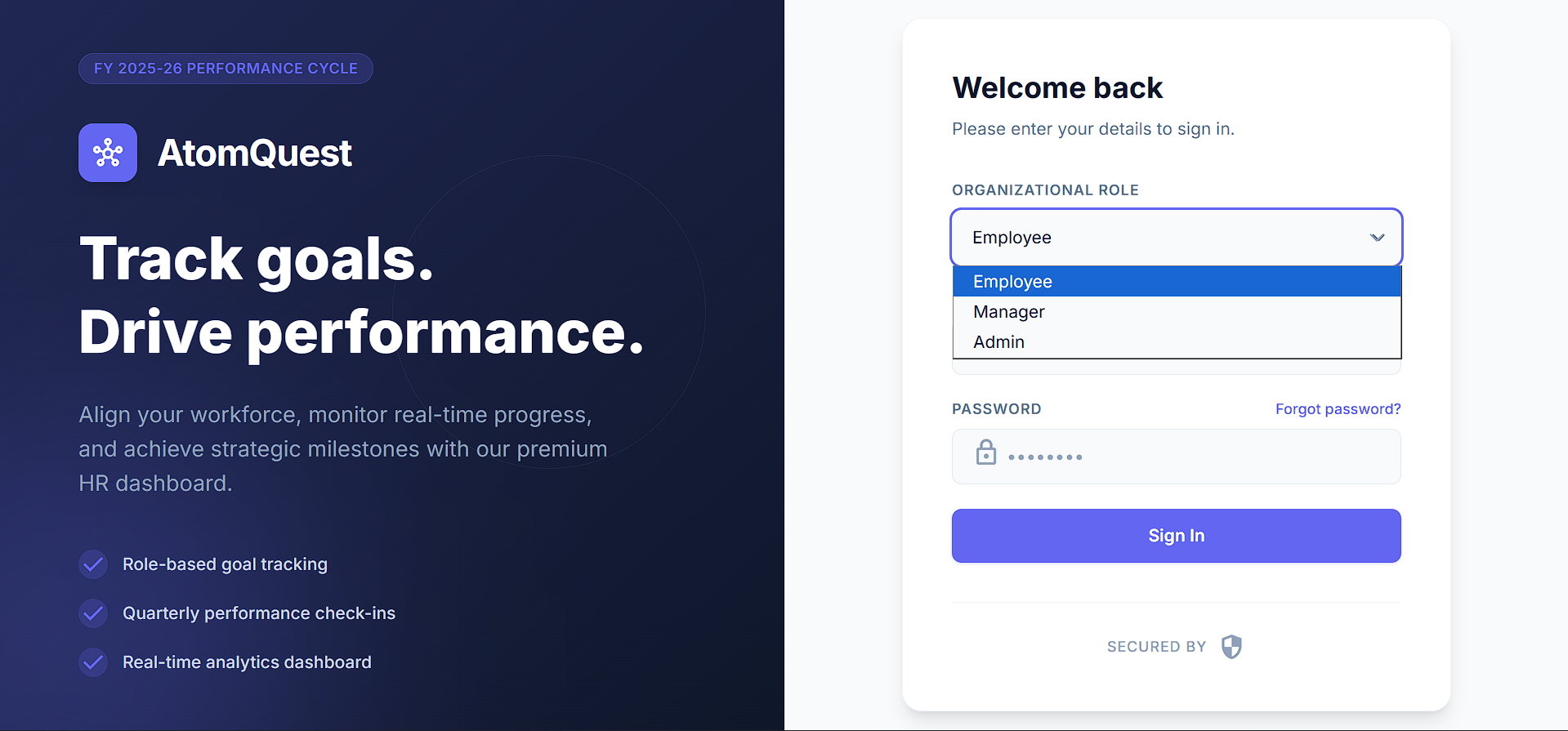
AtomQuest is a full-stack Goal Setting and Performance Tracking Portal that digitizes the entire employee performance lifecycle — from goal creation and manager approval to quarterly check-ins, auto-scoring, and enterprise-wide reporting. It replaces manual spreadsheet-based tracking with a real-time, role-based system built for organizations that need transparency and accountability across hierarchies.
Who It's For
Ideal for developers exploring role-based access control, multi-tenant dashboards, or HR-tech/SaaS products, and for buyers looking for a production-ready internal tool template they can customize for their own organization or portfolio.
Key Features
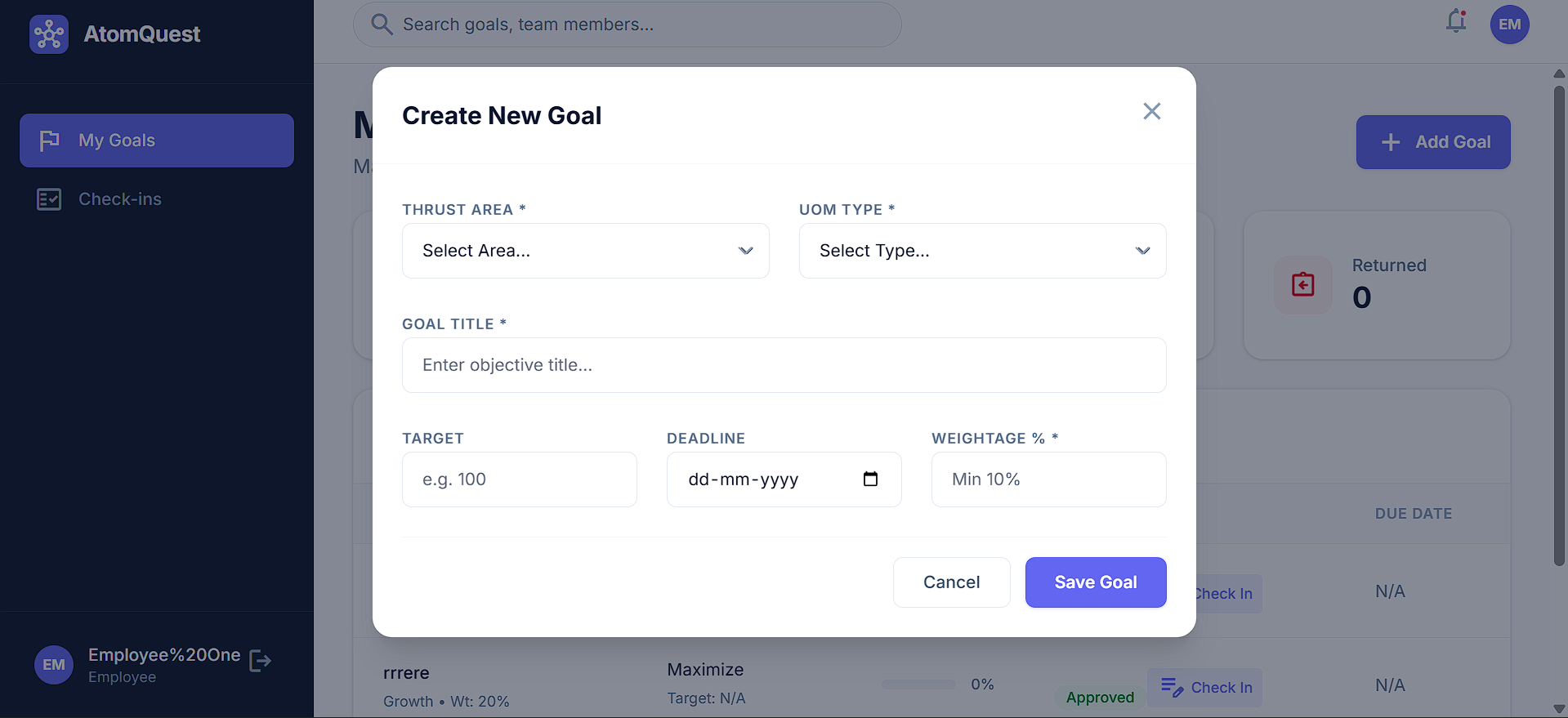
- Employee goal sheets with 4 measurement types (Minimize, Maximize, Timeline, Zero Incident) and server-side validation (100% total weightage, max 8 goals, min 10% each)
- Manager approval workflow — approve & lock, edit inline, or return with feedback
- Admin shared-goal push to multiple employees simultaneously
- Quarterly check-in forms (Q1–Q4) with automatic score calculation per goal type
- Admin completion dashboard with real-time check-in status per employee, per quarter
- One-click CSV export of all goals and actuals
- Full audit log — every post-lock change tracked with timestamp, user, action, and old/new values
- Role-based UI so each user (Employee, Manager, Admin) only sees relevant screens
- Analytics dashboard with charts
How It Works
Built on Next.js 14 (App Router) with Tailwind CSS on the frontend, and Next.js API routes handling all server-side logic and cookie-based authentication. Supabase (PostgreSQL) powers the database with Row Level Security policies enforcing data isolation at the database level — the frontend never talks to Supabase directly, only through API routes. A custom scoring engine (/lib/scoreCalc.js) calculates performance scores using pure, testable functions based on each goal's UoM type.
Tech Stack
Next.js 14, React, Tailwind CSS, Supabase (PostgreSQL), Vercel, custom cookie-based auth
Future Enhancements
- Email/SMS notifications for approval requests, quarter deadlines, and check-in reminders
- Bulk goal import/export via CSV upload, not just export
- Multi-organization / multi-tenant support so the platform can serve multiple companies from one deployment
- Custom UoM formula builder — let admins define their own scoring logic beyond the 4 built-in types
- Mobile app (React Native) for on-the-go check-ins and approvals
- Advanced analytics with predictive performance trends and team comparison dashboards
- Slack/Teams integration for approval notifications and quarterly reminders
- Configurable approval chains — support multi-level manager hierarchies beyond single manager approval
- Goal templates library so admins can quickly assign common goal structures across teams
- Dark mode and customizable theming for enterprise branding
- API access for third-party integrations (HRMS, payroll systems, etc.)
- Role customization — allow admins to define custom roles beyond Employee/Manager/Admin
Known Issues
Known Issues
No email verification on signup — uses simplified cookie-based auth for demo purposes. No mobile app version (web-responsive only). Bulk goal import (CSV upload) not yet supported — goals must be created individually or pushed as shared goals by admin.
Installation
- Clone the repository git clone https://github.com/Sh8ubham/Atom.git cd Atom
- Install dependencies npm install
- Configure environment variables Create a
.env.localfile in the root directory and add your Supabase credentials: NEXT_PUBLIC_SUPABASE_URL=your_supabase_project_url NEXT_PUBLIC_SUPABASE_ANON_KEY=your_supabase_anon_key
(You can get these from your Supabase project dashboard under Settings → API)
- Set up the database Run the provided SQL schema in your Supabase SQL editor to create the required tables: users, goals, check_ins, audit_log, and shared_goals. Enable Row Level Security (RLS) on all tables with the included policies.
- Run the project locally npm run dev
The app will be available at http://localhost:3000
- (Optional) Deploy to Vercel Push the repo to your GitHub account, then import it into Vercel and add the same environment variables in the Vercel project settings for a zero-config deployment.
Usage
Demo Credentials
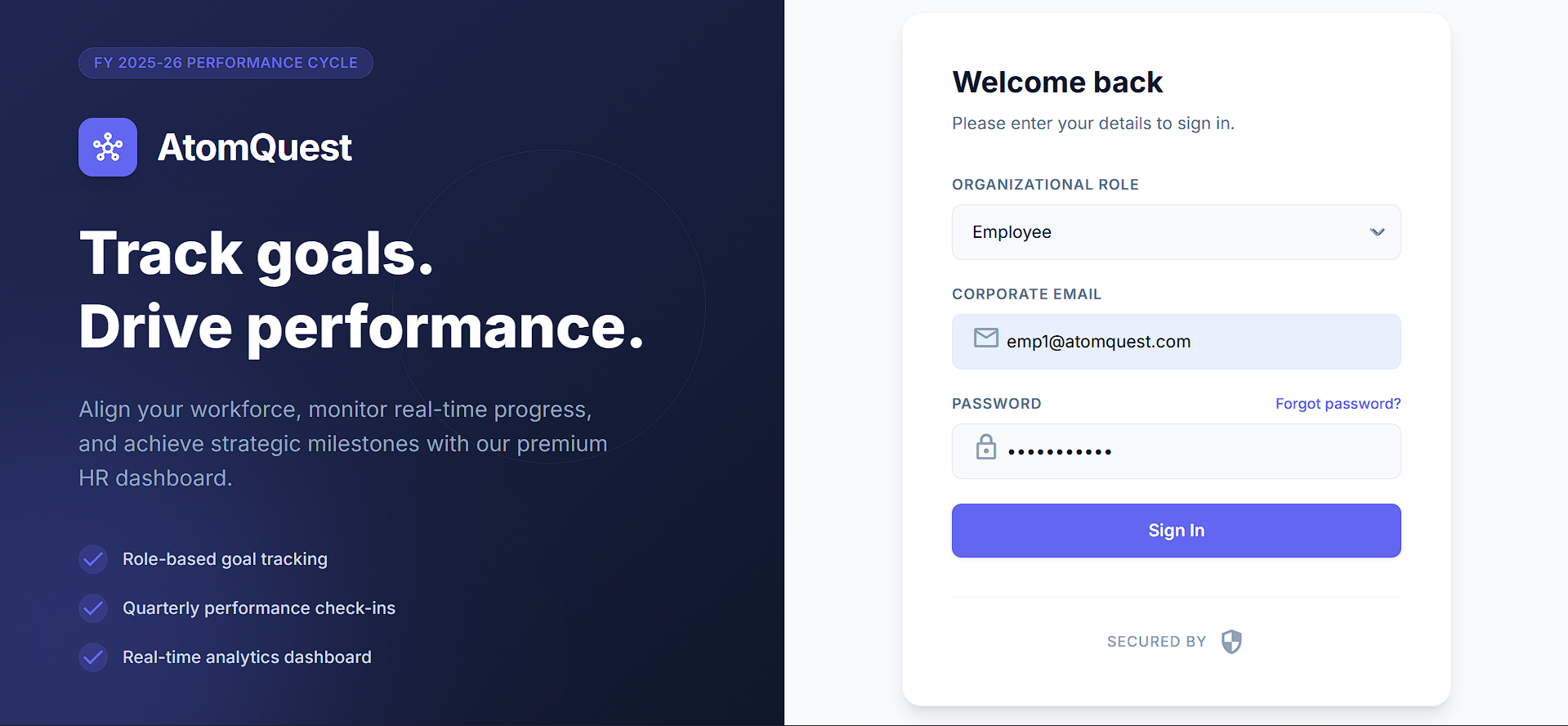
Employee — emp1@atomquest.com / password123
Manager — mgr1@atomquest.com / password123
Admin — admin@atomquest.com / password123
Step-by-Step Workflow
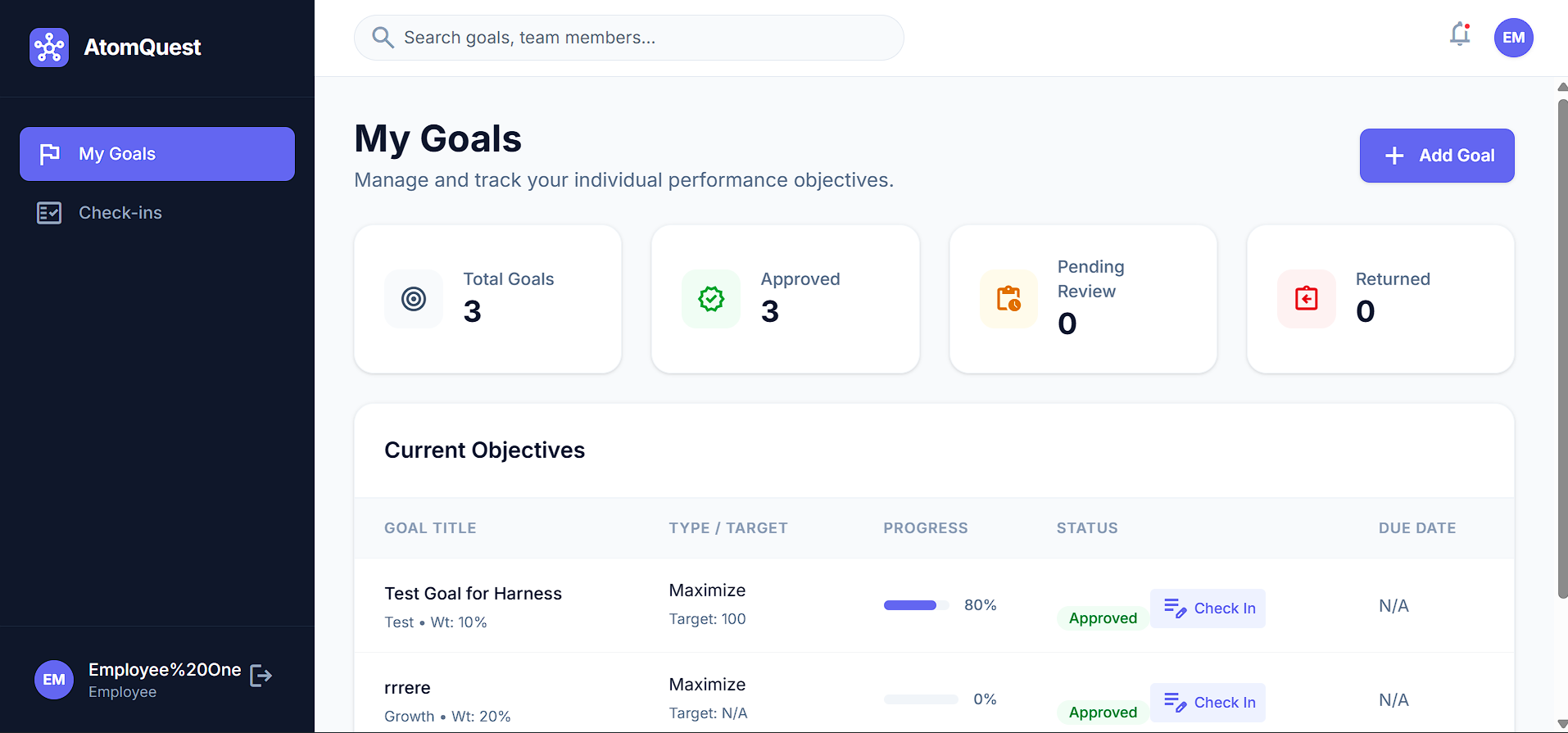
- Login as Employee → Create up to 3 goals with different UoM types (Minimize, Maximize, Timeline, Zero Incident) → Submit for manager approval.
- Login as Manager → Review pending goals → Approve (goal locks permanently) or return with a reason for edits.
- Login as Employee → Complete a quarterly check-in for an approved goal → Score is calculated automatically based on the goal's UoM formula.
- Login as Admin → Open the completion dashboard to see real-time check-in status across all employees and quarters → Export all goals/actuals as CSV → Review the audit log to see every change made after a goal was locked.
- Login as Admin → Push a shared goal to multiple employees at once to test bulk distribution.
Expected Output
- Goals show live status (Pending → Approved/Locked)
- Scores auto-populate on check-in submission using the formula matching the goal's UoM type
- Audit log entries appear instantly for any post-lock change, with timestamp, user, action, and old/new values
System Requirements
Node.js 18.x or higher
npm or yarn package manager
Supabase account (free tier works) with a PostgreSQL database instance
Modern web browser (Chrome, Firefox, Edge, or Safari — latest versions)
Internet connection for Supabase API calls and Vercel-hosted deployment
Minimum 4GB RAM recommended for local development
OS-independent — runs on Windows, macOS, or Linux
Environment variables required: Supabase URL and anon/public API key (buyer will need to set up their own Supabase project or use provided demo credentials for testing)
Slides Open in New Tab
For better readability, slides are opened directly. Documents remain preview-only with secure backend rendering.
Showing preview pages only. Purchase for full access to all pages and complete source package.
Login for Full AccessNo Q&A available yet
Be the first to ask a question!
Ask a Question
Customer Reviews
Write Your Review
No reviews yet
Be the first to review this project!
Similar Projects
You might also be interested in these projects
 Web Apps
AI-Digital-Product-Passport
AI-powered Digital Product Passport platform for intelligent product lifecycle management, predictive maintenance, and sustainability.
 Web Apps
Multi-agent-AI-weekly-planner
WeeklyAI 5 AI agents collaborate in real-time to auto-generate personalized weekly schedules from plain-English goals. Built with LangGraph, FastAPI
 Web Apps
Appointment Booking System
Scalable MERN-based appointment booking system built with microservices, Docker, Redis, RabbitMQ, and secure JWT authentication.
 Web Apps
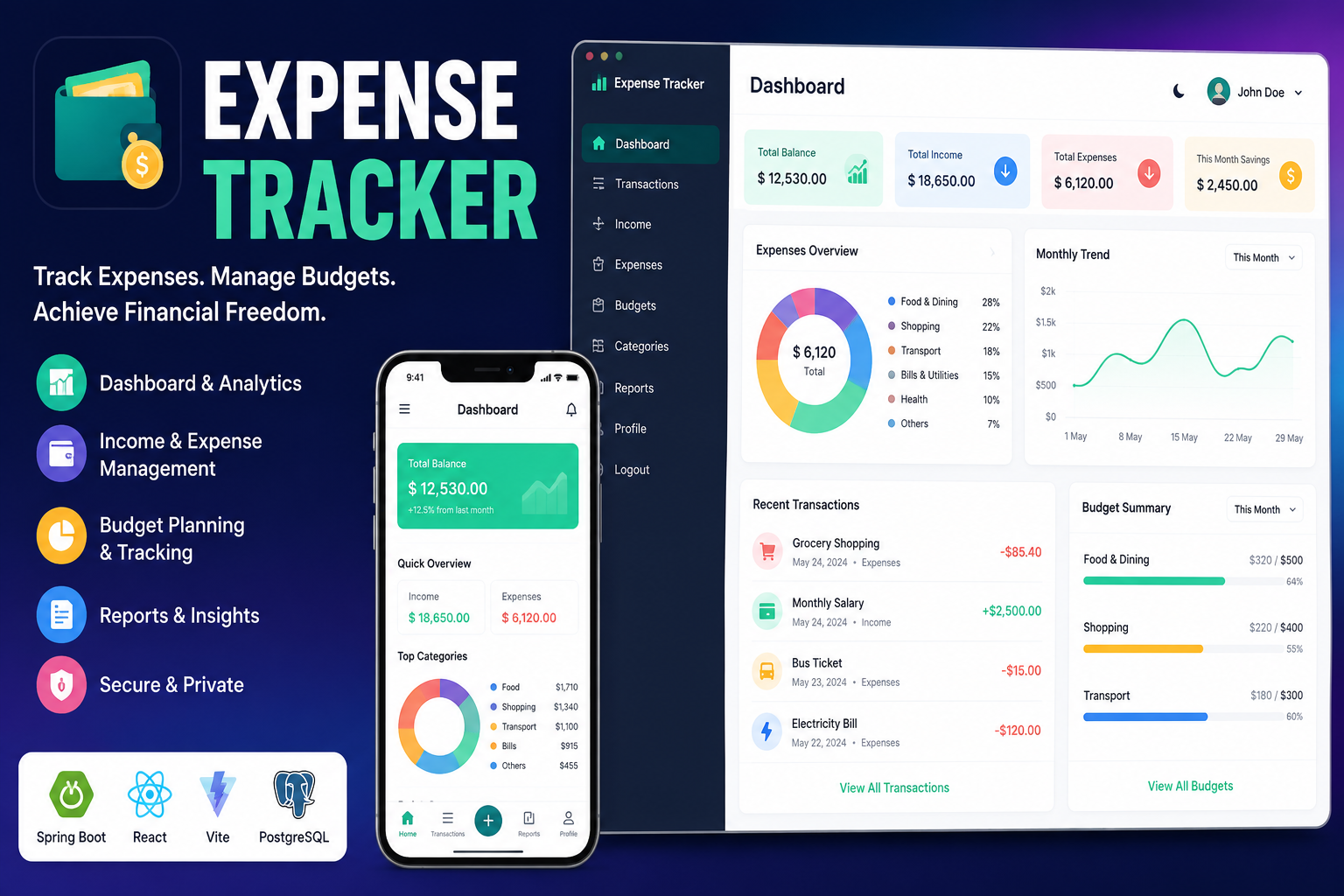
Full Stack Expense Tracker
A modern full-stack Expense Tracker built with React, Vite, Spring Boot, PostgreSQL, and JWT authentication. Track income, expenses, budgets,etc.